Click the hotspots to find out more

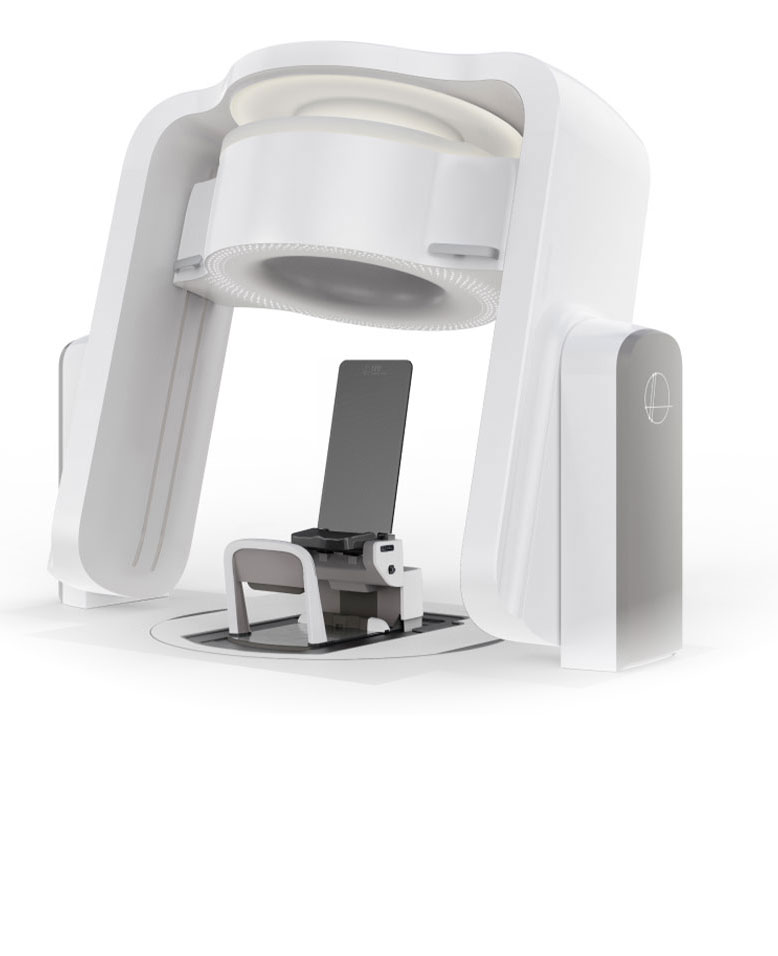
CT Scanner

Upright Fan Beam CT Scanner with a ±15° tilting capability, allowing alignment with the backrest angle

Back Rest

Ultra-thin, lightweight tilting back rest made from carbon fibre

Scanner Arm

Features ±15° tilt capability and a travel range that enables imaging below the pelvis for comprehensive coverage.

Six Degrees of Freedom Platform

With ±1mm isocenter accuracy, our base offers six degrees of freedom, including 360° rotation, X, Y, Z translation, pitch, and roll.

Heel Stop

In the perched position, the heel rest works together with the shin rest to securely support the patient's feet.

Shin Rest

The secret behind our perched position, the shin rest takes the patients weight from the hips down.

Seat Pan

With adjustable height and angle, the seat pan allows for both a seated and perched patient positioning
Meet Marie®

Meet Marie

Named after Marie Curie, a pioneer of radiotherapy, our Particle Therapy solution combines our sophisticated, upright patient positioning system and fan beam CT.

The Marie solution can be placed in front of any fixed particle beam, unlocking modalities such as proton therapy, carbon ion therapy and BNCT. We believe this simple shift to upright positioning will change the particle therapy landscape for good.

Please note: Marie is commercially available in the US, with clearance in other markets in progress

Resources

Everything you need in one place

Resources

Marie Product Brochure Download

Watch Marie in Action

Gantry-less Particle Therapy

“If you need to change a lightbulb, you don’t hold the lightbulb and rotate the house. It always makes sense to rotate the lighter object”

– Stephen Towe, CEO

We remove the need for large and expensive gantries by keeping the radiation beam fixed and instead slowly rotating the patient. This change will aim to bring these previously considered inaccessible treatment to more patients.

Today, centers looking to introduce particle therapy treatments, are recognizing the benefits of this concept, which has the potential to make particle therapy more effective, more accessible and much more patient friendly.

FAQs

Questions are the start of change

Removing the need for a gantry means existing treatment rooms, even linac vaults, can be given a new lease of life, without the need for new costly construction or hospital developments. Our solution Marie, is beam agnostic, meaning it can be placed in front of any fixed beam. Our existing partnership with Mevion Medical Systems provides a compact proton therapy solution that can fit inside a LINAC vault.

Our solution is approximately two thirds smaller than conventional supine technology. In a single gantry vault space, two of our solutions can be installed. Meaning more patients treated, making this previously considered, costly modality, now a commercially viable option.

An increasing number of papers and studies point to its proven ability to target tumor cells more precisely and enable a higher dose of radiation delivered to the tumor, but less radiation to nearby healthy cells, with obvious advantages for patient care.

These advantages result in potentially milder side effects, and cut the risk of developing secondary cancers due to radiation.

Upright radiation therapy is an approach where patients are treated in a seated or upright position rather than lying supine. Leo Cancer Care’s system combines fixed radiation beam delivery, upright patient positioning and rotation, and upright CT imaging to create a complete upright treatment ecosystem. 

This simple shift from lying down to upright is now gaining momentum, with global research indicating the potential for increased organ stability, improved patient comfort, and a simplified system design compared to traditional rotating gantry systems. 

A growing base of research indicates that remaining upright for radiation treatment, our natural position will potentially impact organ motion, setup speed and reproducibility, patient comfort, and access to care 

A great paper to read can be found HERE. 

Upright Radiotherapy is not a new idea and although it is early days for our solutions with first patient treatments on the horizon. To answer this question, we look at the existing research available.  The following areas are being investigated:  

  • Potentially more consistent anatomical positioning: with patients positioned upright, a natural posture, growing global research indicates may support more consistent anatomical positioning and organ stability compared with conventional supine treatments. Here are some of the key papers across key indications: 
  • Yang et al., 2023 – Thoracic Lung Volume 
    • Upright lung volumes increased 25–50%, reducing breathing motion and potentially enabling tighter treatment margins. 
  • Boisbouvier et al., 2023 – Breast Radiotherapy Feasibility 
    • Early research indicated Upright positioning for breast RT as comfortable, feasible, and may improve lung and cardiac sparing. 
  • Siebenthal et al., 2007 – Liver Motion in Supine 
    • When a patient lies down, their liver can drift and deform up to 20 mm, introducing potential errors in respiratory-gated treatments. Recent imaging studies where the participants remained upright saw a more stable liver 
  • Schreuder et al., 2023 – Prostate & Pelvic Stability 
    • It was indicated that the Upright position stabilizes the prostate and seminal vesicles, which may optimize healthy tissue sparing. 
  • Alghadir et al., 2017 – Ease of swallowing upright 
    • This study showed that difficulty swallowing is 6× higher supine; upright may reduce aspiration risk and patient anxiety. 

These indications represent approximately 70%+ of all radiation therapy cases. 

Yes. Early research and testing in real-world installations show that upright setups are reproducible, often matching existing supine accuracy. 

  • The main study that investigated this subject was conducted at Centre Leon Berard, in Lyon, France, where Upright positioning has demonstrated intrafraction reproducibility comparable to traditional couch-based workflows. You can read the study HERE.

Upright treatment allows clinicians to interact eye-to-eye with patients, for some this will help to reserve dignity and reduce anxiety. Many patients report feeling more empowered and less claustrophobic in this position. 

Potential ways being upright can improve the patient experience: 

  • Upright has been reported as a less vulnerable position for many 
  • We spend two thirds of our lives upright; it is a more natural posture. Particularly for those with back pain or breathing problems they report to prefer being upright day to day. 

Yes. Upright radiation therapy is particularly well-suited for pediatric care. 

Children naturally live upright playing, eating, and watching shows seated. Benefits include: 

  • Compatible workflows with general anesthesia (GA) 
  • Gamified and distraction friendly environments 
  • Higher compliance and reduced distress 

Leo Cancer Care collaborates with leading pediatric centers including Stanford, Centre Léon Bérard, and Princess Margaret to validate and expand pediatric upright treatments. 

Traditional radiation systems rotate gantries in some cases for particle therapy, hundreds of tons around a patient. Leo Cancer Care’s approach instead rotates the patient. 

Key differences: 

  • A fixed radiation beam 
  • Smaller footprint – Enabling Proton Therapy to now fit inside of an existing LINAC vault 
  • Reduces the need for new build centers and lowers construction and shielding costs 
  • Faster installation 
  • Simplified mechanical complexity 

We believe that a fixed radiation beam and slow patient rotation is a simpler, smarter concept that provides a platform for innovations such as arc and helical therapy in the future. 

In most cases, we believe upright radiotherapy will provide some cost benefit to health networks.  Here are some examples: For Particle therapy solutions, the sheer size reduction and removal of costly new facility builds present the biggest cost reduction opportunity. 

  • By fixing the beam and reducing the size of the system overall, we anticipate that there will be fewer power and maintenance requirements. However, we are yet to have a study outlining this. 

Upright positioning is supported by peer reviewed research and leading academic institutions, including: 

  • MD Anderson Cancer Center – reduced thoracic motion in upright lung patients 
  • Paul Scherrer Institute (PSI) – elimination of liver drift seen in supine positioning 
  • Sheffield Hallam University – improved comfort and setup for breast patients 
  • Centre Léon Bérard (CLB) – enhanced prostate stability despite bladder filling 

However, we are yet to treat our first patient on the Leo Cancer Care technology, so the growing research available will need to be revalidated on our solutions. There are multiple systems going live in 2026 and further research across the globe taking place to replicate or improve these studies. 

The upright platform is designed to support research into next generation radiation therapy, including: 

  • Arc therapy 
  • MRI guided radiation guided radiation 
  • Online adaptive therapy 
  • Advanced proton delivery techniques 

Due to the simplicity of the fixed radiation beam and high-quality imaging at the isocenter, we believe this is a scalable platform built for the future of radiation oncology. 

Leading institutions worldwide are adopting upright treatment models, across proton and photon therapy, for both research and future clinical implementation. 

You can read some of the case studies here:  

McLaren Proton Therapy Center: Case Study 

UW Health: Case Study

Centre Leon Berard: Case Study

Demonstration

Contact Us for a Demo

Contact us to speak to a member of the team so that we can answer any questions you may have.

Request Demo
Skip to toolbar