
Simulation Solutions
SIMULATION
THE MISSING PIECE OF THE UPRIGHT PARADIGM
Early radiation treatments in the 1940s were delivered with patients in an upright position, mirroring the body’s natural state. Clinically, it made sense. But as many patients with cancer were diagnosed late and often too unwell to stand, this approach became difficult to sustain.
Now, medical centers around the world are revisiting this more natural posture and preparing to implement upright treatments into routine practice. The key barrier has always been imaging – the missing link.
Until now.
Solutions that grow with you
As upright treatment volumes grow, your department needs simulation solutions that scale with you.
By integrating dedicated simulation and imaging systems, you keep your treatment room focused on what matters most: patient care. The result? Higher throughput, smoother workflows, and greater clinical efficiency.

Click the hotspots to find out more
Treatment room
Marie is a beam‑agnostic particle therapy solution combining an upright fan‑beam CT scanner and upright patient‑positioning system, compatible with any fixed particle beam. With its isocentric CT scanner, Marie enables in‑room simulation and treatment, bringing your full workflow into one seamless space.
Simulation Room - Aida
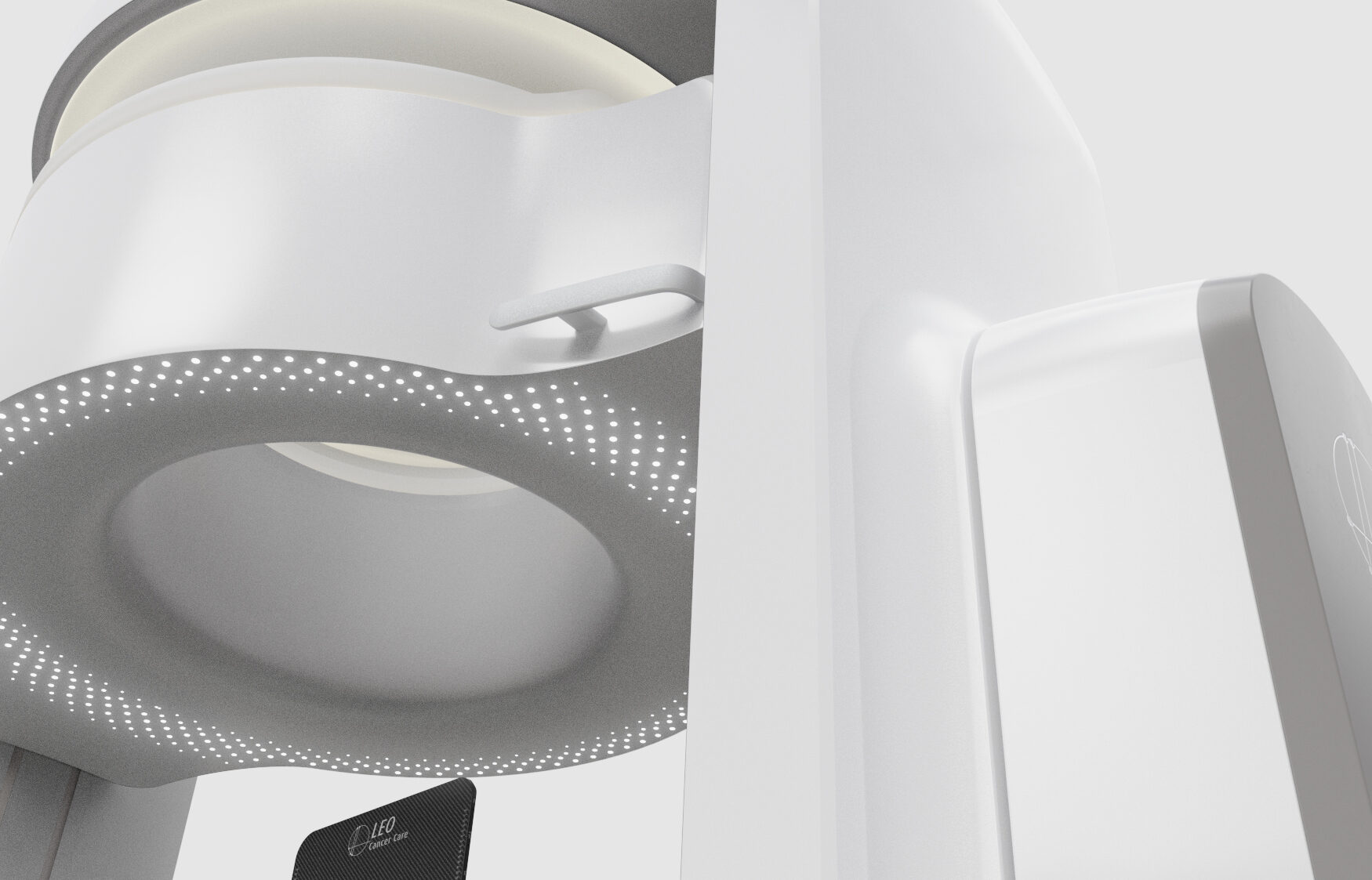
As demand for upright treatments grows, so does the need for a dedicated CT simulation solution. Aida is our upright fan‑beam CT scanner, installed in a separate imaging and simulation suite to improve workflow and boost patient throughput.
Simulation Room - Eve
A simple yet powerful solution: Eve, our static patient‑positioning system. Eve reduces the time needed for CT planning in the treatment room. By allowing clinicians to create treatment devices outside the treatment space, it significantly shortens CT planning time, improving workflow and increasing throughput.
Explore more
Everything You Need to Dive Deeper

Named after Florence Ada Stoney, the UK’s first female radiologist, Aida integrates upright positioning with and CT imaging. The result is a purpose-built upright simulation solution that enhances and expands your department’s capabilities.

Eve is our static upright patient‑positioning system for use outside the treatment room. It lets patients experience and practice their setup in a low‑stress environment, improving comfort and confidence. It also allows staff to train, test, and refine workflows without interrupting clinical operations, helping teams optimise precision and efficiency before entering the treatment room.
FAQs
Questions are the start of change
Simulation plays a critical role between a patient’s consultation and the development of their treatment plan. It is typically the longest appointment in the radiation oncology department, and for many patients it is an unfamiliar and uncomfortable experience. Upright seeks to make this process significantly easier for the cancer patient.
It is essential that patients are imaged during simulation in the same position in which they will be treated, ensuring that organ drift and deformation are accounted for and improving overall treatment accuracy. Historically, treatment and therefore simulation have been performed in the supine position. These appointments usually last around an hour and give patients their first opportunity to meet the clinical staff and become familiar with the equipment used in their treatment, including immobilization devices that help ensure stable positioning. Upright simulation has the potential to offer a level of comfort and ease not commonly achieved with traditional supine positioning. We believe upright simulation and radiotherapy will improve patient comfort, streamline workflow, and enhance clinical efficiency, including overall throughput.
Fan-beam CT is required for treatment planning. The X-Ray source and detectors rotate around the patient quickly (equal to or greater than one rotation per second) and captures thousands of imaging frames per second, giving it excellent contrast, resolution, and motion robustness. Fan beam CT allows for better scatter reduction technologies and subsequently better CT image quality.
Cone-beam CT (CBCT) is typically mounted on treatment machines and was originally developed for X-ray and fluoroscopic imaging. It provides volumetric images but with slower acquisition speeds, lower contrast, and greater sensitivity to motion artefacts.
Fan-beam CT provides:
- Higher image contrast
- Less impact of scattered radiation
- Produce 3D images faster to support better imaging
- Superior motion handling
- More accurate Hounsfield values for dose calculation
- Finer slice thicknesses
These properties make it the gold standard for simulation and adaptive planning. (Source)
Leo Cancer Care provides a portfolio of upright simulation tools designed to grow with your department:
- Eve – a static upright patient positioning system for optimizing setup posture and preparation of custom immobilization. This does not require an x-ray shielded room.
- Aida – the capabilities of Eve and the addition an upright fan-beam CT scanner for a dedicated simulation room
These solutions can be adopted individually or together as clinical volume increases.
- Footnote: Marie – a beam agnostic upright particle therapy system with integrated upright CT at isocenter can also be used as a simulation. Learn More about Marie.
Eve is a static upright patient positioning system used outside the treatment room.
It enables
- Optimization of setup posture and creation of immobilization solutions before entering the treatment room
- Patient education and familiarization in a low stress environment
- Simulation of treatment setups
- Staff training, workflow testing, and research without disrupting clinical operations
This dramatically reduces the time needed for CT planning in the treatment room. It’s well suited for centers experiencing a sharp increase in patient volume.
Aida includes Eve as well as Leo Cancer Care’s dedicated upright fan-beam CT scanner placed in a simulation room outside of treatment, freeing up valuable clinical space.
It provides:
- Treatment planning-quality upright CT
- Supports enhanced workflow and patient throughput
- A purpose-built simulation experience aligned with upright treatment positioning
Aida consists of the core imaging components of the Marie system, adapted for use outside the treatment room.
| Solution | Simulation | Daily Patient Volume | Best for Centers with | Simulation Efficiency |
| Marie |
Simulation done inside the treatment room |
Centers managing a lower patient volume |
Gradual increase in patient volume |
Full Simulation occurs in treatment room |
| Eve |
Setup optimization and customer immobilization preparation |
High-volume or expanding centers | Rapid increase in patient volume | Reduces treatment room time during simulation |
| Aida |
All simulation activities done on Aida, outside the treatment room |
High-volume centers | Complete buy-in of upright treatments | Traditional simulation workflow fully externalized |
Key planning quality CT specifications include:
- Bore size: 84 cm
- Field of view: 62.3 cm
- Imaging energies: 80 kV & 140 kV
- Gantry tilt: ± 5°, 10°, and 15°
- Travel range: 160 cm
- Slice thickness: 1–4 mm
- Rows: 32
- Upright positioning features: adjustable seat pan angle (0–60°), ±15° backrest, shin/heel support, designed for use with specific immobilization devices such as:
- Vac-lock bag for hip support
- Inflatable abdominal belt
- Upright arm support
- Shoulder and head mask
These features allow flexible, stable upright imaging for a wide range of clinical needs.
Before CT simulation, setup was performed using plain film radiography and fluoroscopy, producing only 2D images and requiring beam arrangements to be decided during the simulation session. CT simulation introduced high-resolution 3D imaging, allowing beam arrangements to be determined in treatment planning and not at the time of simulation, which significantly reduced the duration of simulation appointments.
Key changes introduced by CT:
- Improved planning accuracy through detailed 3D anatomical visualization
- Enabled more reliable dose calculations using volumetric data
- Allowed fusion with other imaging modalities (MRI, PET)
- Established CT-only or CT+MR/PET workflows as standard practice
Leo’s simulation solutions introduce new degrees of freedom in patient positioning. We believe Leo Cancer Care’s simulation platform will reduce bottlenecks by:
- Shifting immobilization and device creation outside the treatment room
- Allowing multiple staff roles to train without impacting patient schedules
- Providing a more comfortable and less intimidating first experience for new oncology patients
- Enabling patients to simulate treatment positioning before delivery (SIM verification)
- Increasing throughput by dedicating the treatment room solely to delivery
Together, these steps will create a more efficient, patient-centered workflow. We believe that a comfortable patient produces less motion and hence greater accuracy.
Some solutions shown in the brochure are pending regulatory clearance in certain markets and may not yet be commercially available. (Grace and Aida)
As upright treatment volume increases, simulation needs expand.
Leo Cancer Care’s modular approach allows centers to:
- Start with Eve for positioning and training
- Add Aida for dedicated upright CT simulation
- Integrate with Marie to improve treatment workflows
This ensures a smooth upgrade pathway aligned with each department’s clinical trajectory. Leo Cancer Care’s simulation and treatment solutions offer a flexible, mix and match approach designed to meet the unique needs of each center.
Some centers use CT on rails to bring a diagnostic fan-beam CT into the treatment room.
- Pros: higher image quality as compared to cone-beam CT
- Cons: because the patient must be moved across the room between imaging and treatment, this workflow adds complexity and increases the risk of misalignment. Centers using recumbent CT-on-rails systems face additional challenges, as the approach requires a labor-intensive physics process to reconcile two separate isocenters, the imaging isocenter and the treatment isocenter. It also demands that the patient be repositioned without any movement, which is difficult to achieve consistently. These factors have limited the widespread commercial adoption of this solution.
To reduce uncertainty, the ideal workflow is:
- Position the patient in treatment posture
- Acquire fan-beam CT in the same position
- Generate, verify, and adapt the plan
- Deliver immediately
Upright fan-beam‑ CT enables this without moving the patient, supporting the next generation of adaptive radiotherapy.
A platform built for the future, should take advantage of the advances on the horizon. One such advancement is adaptive therapy, which has been slow to be adopted. The largest reason for that slow adoption is the absence of treatment planning ready imaging in the treatment room and treatment position. CBCT has been a compromise to that process.
The field is rapidly moving toward:
- Faster, planning quality CT imaging
- Daily adaptive radiotherapy
- Automated contouring, planning, and QA
- Integrated imaging and treatment workflows
Better imaging enables better treatment, and the future of radiotherapy will rely on fast, reliable, planning‑quality CT acquired directly at the point of care. High‑quality imaging is becoming increasingly central to radiotherapy, with greater use of MR imaging, PET imaging, and in‑room fan‑beam CT. Together, these advances underscore the growing need for diverse, advanced imaging capabilities available right where care is delivered.
Learn More about Upright Radiotherapy
We believe upright simulation and radiotherapy will improve patient comfort, streamline workflow, and enhance clinical efficiency, including overall throughput.
Why Upright