Blog
Leo Cancer Care: Concept to Reality
June 18, 2026
The Evolution of Radiotherapy
Every year, more than 12 million people worldwide receive radiotherapy as part of their cancer treatment.
Despite more than a century of technological progress, the patient experience has changed surprisingly little. At Leo Cancer Care, we believe it is time to rethink not only how radiotherapy is delivered, but how patients experience it.
Early radiotherapy treatments were rudimentary. Patients were often seated while radiation beams were directed toward the tumor site using large block fields.
Major advances followed: the rotating gantry in the 1950s, collimation in the 1960s, and 3D planning in the 1970s. These innovations required patients to lie supine while radiation beams moved around them, improving precision and outcomes.
Since then, engineering has advanced dramatically whilst the patient experience has not. Are we simply building larger, more complex systems without questioning whether that is the right direction? In an era defined by miniaturization and patient-centered design, why hasn’t radiotherapy followed suit?
Rethinking the System
Leo Cancer Care was founded in Australia in 2016 (originally Nano-X) with a bold question: what if radiotherapy systems could be smaller, simpler, and more patient-centered?
The team identified a critical insight: by fixing the radiation beam and rotating the patient, rather than rotating the radiation around the patient, system complexity and cost could be significantly reduced.
From Concept to Prototype

In 2017, the concept took a major step forward. The first upright prototypes were developed, bringing the vision to life and setting the foundation for Leo’s future.
Innovation in healthcare is rarely straightforward. Reimagining a field that has seen little fundamental change in 100 years requires persistence and conviction.
In 2018, Leo Cancer Care navigated significant challenges. Stephen Towe stepped in as CEO, guiding the company through key decisions and maintaining momentum toward realizing the vision.
Turning Point: Building Momentum
In 2019, Leo Cancer Care reached a turning point. To move forward, the company needed investment and to secure it, others had to believe in a better way to deliver radiotherapy. So our messaging became louder and clearer.
With funding in place, the team expanded rapidly, bringing in leading experts from across the radiotherapy space and further into healthcare, to transform the concept into a tangible system.
In 2020, as the global pandemic slowed the world, Leo Cancer Care continued to progress. Engineering efforts were split between the US and UK: the UK team focused on patient positioning, while the US team advanced the upright CT scanner.
In 2021, the first upright patient positioning system was installed at Centre Léon Bérard, where it remains a hub for pioneering upright radiotherapy research. As an early clinical partner, the center became a key collaborator in advancing the technology.
Major Milestones

2022 saw the UW Health become the very first center in the world to sign with Leo Cancer Care outside of a research agreement. They immediately started construction of their new medical center that would one day house the Leo Cancer Care technology.

From 2022 onward, Leo Cancer Care established a strong presence at leading oncology conferences, demonstrating the full treatment system and building awareness of upright radiotherapy as a refined, modern approach, not a new idea, but a reimagined one.
Strategic partnerships have further demonstrated the versatility of the technology across multiple modalities, including protons, photons, carbon ions, BNCT, and FLASH electrons.
FDA Clearance: A Defining Moment
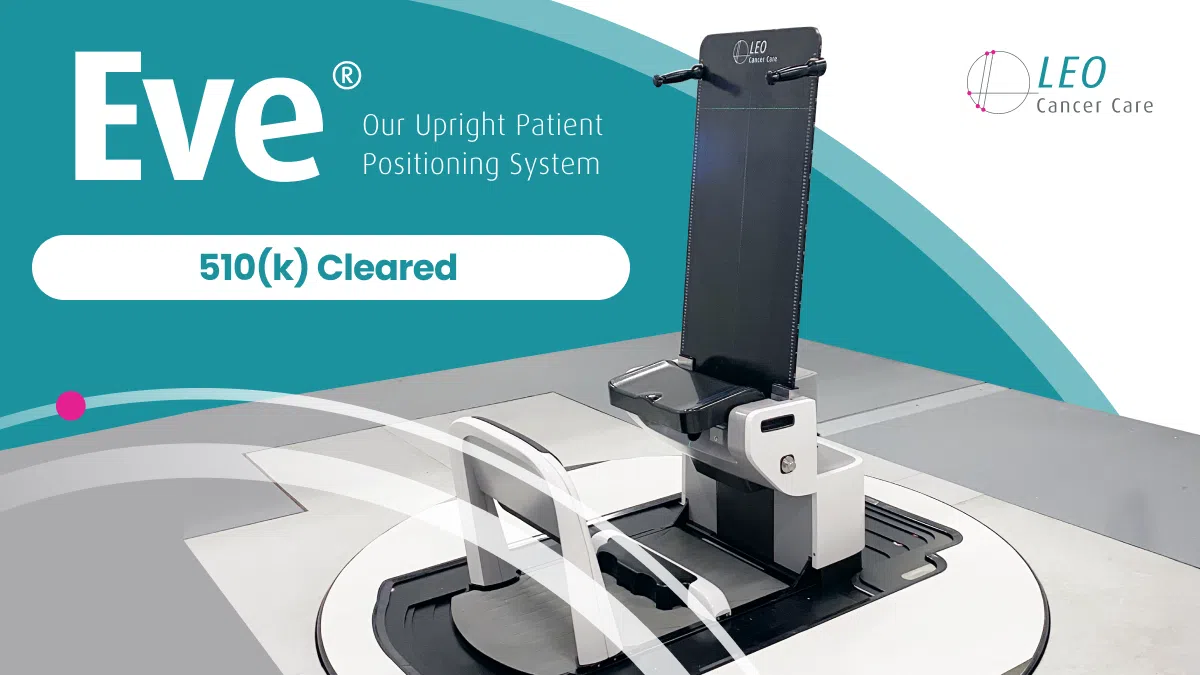
In May 2024, Leo Cancer Care reached a significant milestone with FDA 510(k) clearance for its upright patient positioning system, Eve. As the first system of its kind globally, this achievement marks an important step in advancing the company’s innovation and reinforcing the strength of its positioning in the market.
Eve sits at the core of Leo’s technology platform, supporting patients, improving comfort, and placing them at the center of the treatment experience.
Expanding Clinical Capability
Following closely behind Eve, in July 2025, Marie, Leo Cancer Care’s particle therapy solution, also received FDA 510(k) clearance. By integrating upright positioning with an upright CT scanner, Marie enables use in front of any radiation beam. This was the most significant step toward clinical adoption as it allowed for a method of simulation and verification of treatment.

The Future of Radiotherapy
Beyond technical achievements, one of the most meaningful shifts has been in industry perception. Conversations about upright radiotherapy no longer begin with “if,” but with “when.”
Patients themselves have played a vital role in shaping this technology. Their insights have directly influenced system design, ensuring that the future of radiotherapy is built not only for patients, but with them.
Innovation often begins as a simple idea. Turning that idea into reality, especially in healthcare, requires expertise, collaboration, and persistence.
As of June 2026 Leo Cancer Care achieved its ultimate mission, treating our first patient, a moment that represented years of dedication, innovation, perseverance, and belief. What may appear as a single achievement is the result of an incredible team working together with one shared purpose: improving the experience of cancer treatment for patients around the world.

This represents more than a technological milestone. It marks the beginning of a new chapter in radiotherapy, one that prioritizes patient comfort, expands treatment possibilities, and redefines what cancer care can feel like.
The journey from concept to reality is only the beginning.
Subscribe to our newsletter
STAY CONNECTED
Get the latest updates and exclusive offers delivered straight to your inbox
Subscribe